
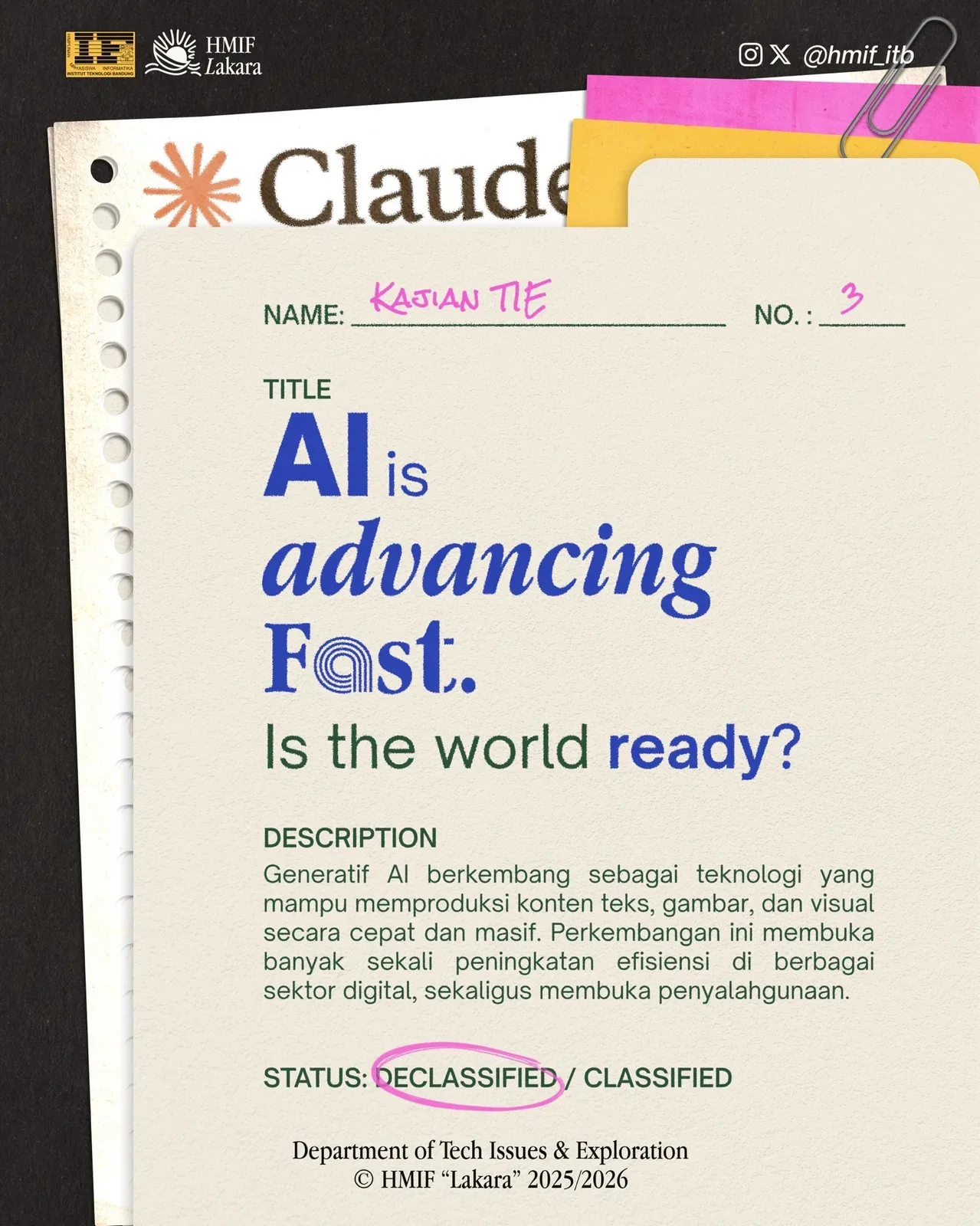
AI is advancing fast: is the world ready?
Written by Princessfa A. (STI'23)in Department of Tech Issues and Exploration5 min read5 Mar 20260 viewsGenerative AI has grown into a technology that produces text, images, and video quickly and at scale. It opens the way to big efficiency gains across the digital sector, and it also opens the way to misuse. This Kajian TIE piece was first posted in Indonesian on HMIF's Instagram in March 2026, and this is its English translation.
The new creative engine
AI is no longer only a tool for analysis. It creates new things such as stories and code, realistic images, video, and even music and synthetic voices. At the time of writing, well-known models for multimodal text generation included GPT-5.3 from OpenAI, Gemini 3.1 Pro from Google, Claude Opus 4.6 from Anthropic, and Grok 4.1 from xAI.
When AI goes wrong: abuse, deepfakes, and copyright
The news in early 2026 showed the risks. The Washington Post reported on an AI start-up's plan to scan and dispose of millions of books. The New York Times estimated that Grok flooded X with millions of sexualised images in days. A trade group representing Studio Ghibli and other Japanese companies told OpenAI to stop using their content to train its Sora 2 video generator.
The hidden costs of AI: environment and jobs
Training GPT-4 is estimated to have cost more than 100 million dollars, about 1.68 trillion rupiah, and to have used 50 gigawatt-hours of energy, roughly three days of electricity for San Francisco. Sam Altman, the CEO of OpenAI, answered that people talk about how much energy it takes to train an AI model, but it also takes a lot of energy to train a human. He called the public's judgement of AI's energy use unfair, and added that the world needs to move to nuclear or wind and solar power very quickly.
Beyond energy, generative AI also puts jobs at risk of being replaced. Speaking at a Federal Reserve conference in Washington in July 2025, Altman said of customer support roles that some areas would be totally gone.
Who's regulating AI? A global snapshot
Several countries have started to act. The European Union passed its AI Act, China issued interim measures for generative AI services, South Korea passed a framework act on AI, and the United States, through states such as California, has begun drafting AI rules. A few of their provisions show the direction:
- The EU AI Act and Korean law require that AI-generated content and deepfakes be clearly disclosed.
- China's interim measures require providers to handle misuse of their technology, from warnings up to ending service for users who break the rules.
- The EU AI Act requires that training data respect copyright, and that providers be transparent about the data sources they use.
- China's interim measures require that data used to train generative AI meet the legal requirements set for it.
These are only a few points from each regulation, which in full are very detailed. Regulation is starting to answer the real risks that come with AI.
Indonesia and AI: where do we stand?
As of March 2026, Indonesia had no regulation written specifically for artificial intelligence. Existing policy was general and scattered. Stranas KA 2020, the national AI strategy, is not a legal regulation. Current rules lean on the Electronic Information and Transactions Law, the Personal Data Protection Law, and Circular Letter No. 9 of 2023 on AI ethics, which is voluntary.
Through Presidential Decree No. 38 of 2025, the President set two draft presidential regulations to be passed in 2026. One is on AI ethics, and the other is on a national AI roadmap for 2026 to 2030. The aim is to institutionalise binding ethical principles that support national priorities and respond to fast-moving geopolitics and technology risks. AI regulation in Indonesia is still developing, and it is heading toward a clearer and more structured legal framework.
Indonesia's next move in the AI era
If AI keeps growing, what would ideal rules for Indonesia look like? Some ideas have emerged:
- Risk-based classification. Strict audit standards for AI in critical sectors such as health and infrastructure, with more flexibility for low-risk innovation.
- Transparency and watermarking. Mandatory labels and digital identity on all generative AI content, such as text, images, and video, to reduce disinformation.
- National data sovereignty. Priority for local datasets when training AI models, to keep cultural relevance and to comply with the Personal Data Protection Law.
- Regulatory sandboxes. Legal test spaces where local developers can validate technology before commercial release, without rigid bureaucracy.
Communities and AI: growing responsibility together
AI is growing fast and has a large impact on society, so it cannot be handled by individuals alone. Community initiatives can help build public understanding of ethical AI and raise issues that get little attention, such as its effect on the creative field. Programmes like AI Ready ASEAN are one example.
On the community side, that means building AI literacy through workshops, discussions, and public education, encouraging ethical use and raising overlooked issues, and starting small, such as being open about AI use in everyday work. On the development side, it means encouraging discussion between developers and non-developers so AI stays oriented to people, making sure development considers fairness, safety, privacy, and social impact, building a culture of dialogue, literacy, and shared responsibility, and balancing technological progress with ethical values. Through that collaboration, AI can grow not only more advanced but also more ethical, inclusive, and useful to society.
You and AI: using it wisely as an individual
- Verify and validate. Always double-check information produced by AI. Do not take it at face value, because AI can still hallucinate.
- Protect personal data. Avoid putting sensitive information, such as financial data, company secrets, or identity details, into public AI platforms.
- AI as an assistant, not a replacement. Use AI to speed up research and technical work, but keep human critical thinking and creativity in control of decisions.
- Digital literacy. Learn how AI works and the ethical rules around it. Knowing the limits of the technology helps you avoid manipulation and disinformation.
The bottom line: shaping AI with responsibility
AI will keep growing. That much is certain. What is not certain is how we choose to use it. With understanding, regulation, and shared responsibility, AI can be a tool for progress rather than a threat.
The future of AI is our future too. Don't just use AI, understand it.
Credits
- Content writer
- Princessfa A. (STI'23)
- Graphic designer
- Bagas N. F. (STI'23)
- Writers
- Andi Farhan (IF'23), Alfian Hanif (IF'23), Muhammad Akmal (IF'24), Jennifer Khang (IF'24), Kurt Mikhael (IF'24), and Faris Wirakusuma (IF'24)
Department of Tech Issues and Exploration, HMIF ITB 2025/2026