
Studying informatics: what should you master in the AI era?
Written by Yohanes Nicholas S. (IF'25)in Department of External3 min read3 Nov 20260 views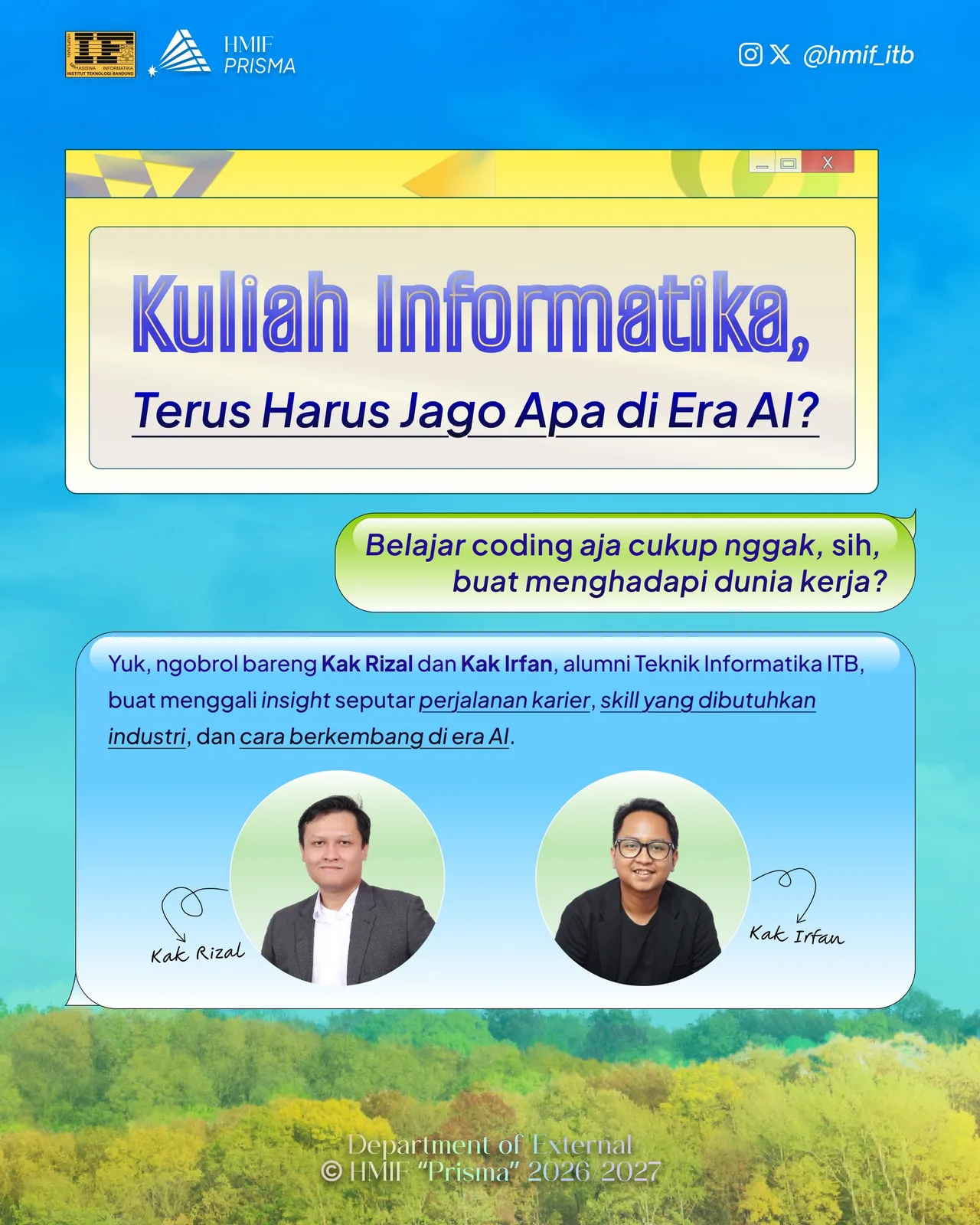
Is learning to code enough to face the working world? At Alumni Connect, HMIF members sat down with Kak Rizal and Kak Irfan, informatics alumni of ITB, to talk about career paths, the skills industry needs, and how to grow in the AI era. This recap was first posted in Indonesian on HMIF's Instagram, and this is its English translation.
If AI can help with coding, do fundamentals still matter?
AI already helps across software development, from planning to coding to testing. But what AI produces still needs to be validated.
Problem-solving skills and a grasp of the fundamentals still matter for finding the right solution.
Do coursework assignments matter at work?
It turns out the experience of doing coursework can be a real asset when a career starts.
Courses like object-oriented programming, computer networks, operating systems, and parallel systems can be useful in software engineering work.
A final project or other projects can help a fresh graduate explain what they can do and what they have done.
So it is not only about grades or results. It is also about what you learned and the story you can tell about the process.
The T-shaped engineer: generalist or specialist?
In the AI era, understanding several fields helps you see a problem from different angles.
Informatics students should understand the concepts of several fields, such as backend, frontend, data, and AI, without going deep into all of them.
Explore several fields first, then go deep into the one that fits you best.
This matches the idea of T-shaped skills, which pair a broad understanding with one field of deep expertise. So, do you already know what you want to go deep into, or are you still exploring?
A master's abroad: worth it or not?
How much does a master's degree matter for a job? There is no universal answer. In industry, practical experience is often valued more than formal education.
If you want a master's, do it because you want to, not to chase your next career step. But if you get a scholarship, go for it!
Startup or corporate?
Both can be good choices, depending on each person's situation and goals. Choosing where to work means weighing economic conditions and income needs.
If you need a stable income, a corporate job can be the more sensible choice.
On the other hand, choosing a workplace also means weighing the chance to keep growing.
From coursework to work: what changes?
At university, group assignments train us to work with other people, but collaboration is not always easy. Kak Irfan shared that he was once too idealistic about his own way of doing things and ignored his teammates' opinions. From that experience, he learned that working together produces better solutions.
Kak Rizal pointed to ownership. When we build something at work, we share responsibility for solving the problems that come up.
Still unsure what you want to become?
That is okay. You do not need to know everything now. Explore, gather experience, keep learning, and do not be afraid to try, because every experience prepares you for your career. So, what is your next step?
Credits
- Content writer
- Yohanes Nicholas S. (IF'25)
- Graphic designer
- Amanda Trishya Aulia (STI'24)
Alumni Relations division, Department of External, HMIF ITB 2026/2027