

Your phone is listening... isn't it? How personalised ads really work
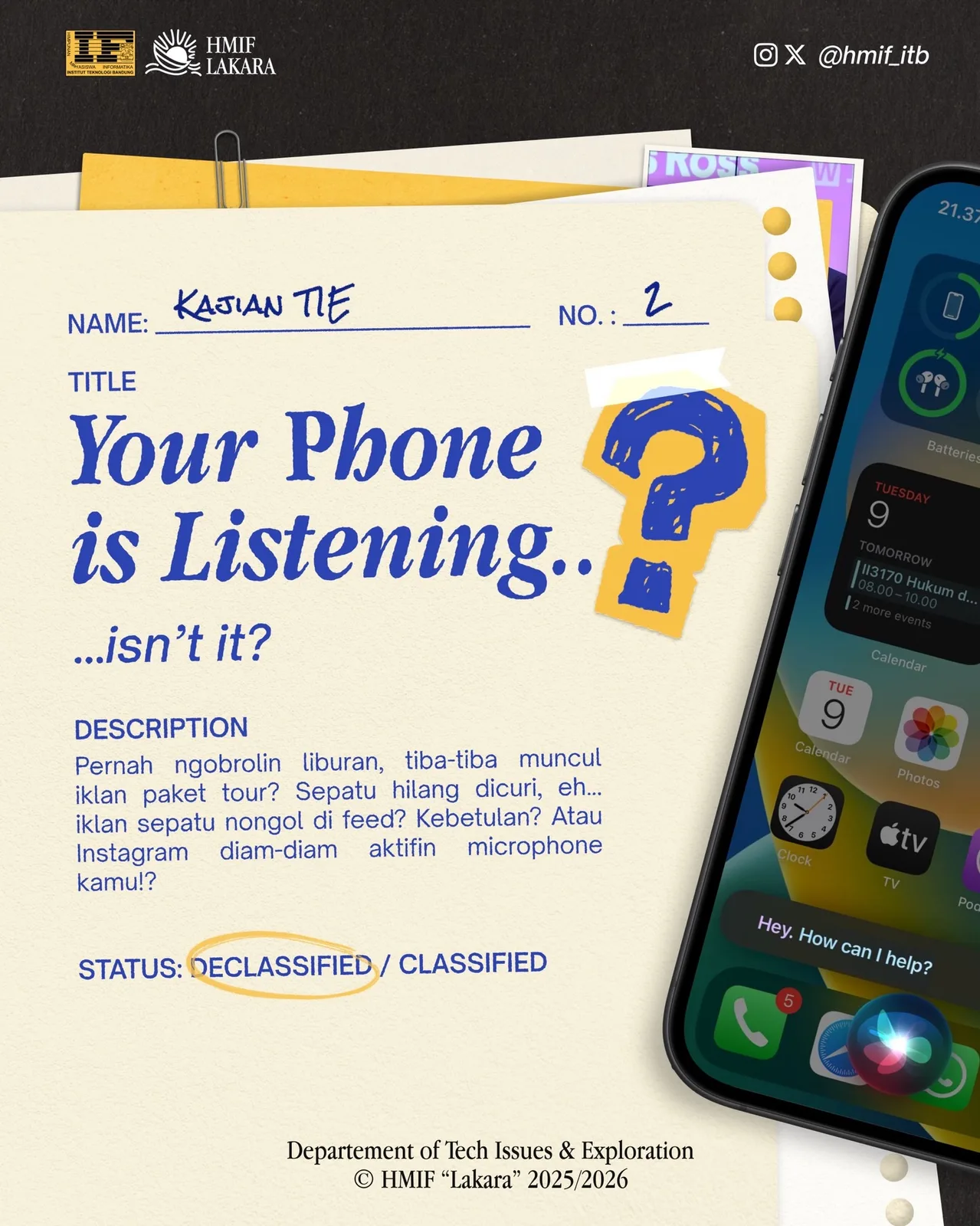
Written by Salsabilla (IF'22)in Department of Tech Issues and Exploration5 min read5 Jan 20260 viewsYou talk about a holiday, and an ad for a tour package appears. Your shoes go missing, and a shoe ad shows up in your feed. Coincidence? Or is Instagram quietly turning on your microphone? This Kajian TIE piece was first posted in Indonesian on HMIF's Instagram, and this is its English translation.
The myth that makes us paranoid
From Quora posts to viral stories on social media, everyone asks the same question. Do social media apps really listen to our conversations? The worry grew so loud that Adam Mosseri, the head of Instagram, spoke about it himself.
The CEO speaks out
Mosseri said plainly, "We do NOT listen to you." If Instagram listened to users' conversations, he said, it would seriously violate their privacy, drain device batteries in a way users would notice, and turn on the microphone indicator on the device.
Then why do ads seem to know what we talk about?
So why does it feel like they know?
There are several reasons an ad can match what you were talking about:
- You have already interacted with the topic, by clicking, commenting, liking, or sharing.
- You have already searched for or browsed the topic on another platform.
- Instagram and advertisers work with websites to track who visits a topic.
- Instagram shows ads based on what your friends, or people with similar interests, like.
- You may have seen the ad before without noticing, and then talked about it in real life.
What are personalised ads?
Personalised ads are adjusted to a person's traits, interests, behaviour, and demographics. They use data collected from online activity, such as browsing history, location, and purchases. They exist because they are efficient. Ads reach the right people, users see more relevant ads, and advertisers are more likely to succeed. In short, they are ads aimed at you based on your interests.
How does it actually work?
- Data collection and profiling. Instagram records your activity, such as who you follow, what you like and comment on, and which posts, reels, and stories you watch, and for how long. Meta Pixel tracks your browsing on other websites, and demographic data adds your age, gender, and location. Users are then sorted into categories like "programmer", "football player", or "gamer", and one user can sit in many categories.
- Advertisers set up campaigns. They choose the target audience and placements, such as stories or reels, through Ads Manager.
- Ad auctions. Every time you open Instagram, an ad auction runs in a fraction of a second. The winner is not the highest bidder but the ad with the highest total value, which combines the advertiser's bid, the ad's quality, and an AI estimate of how likely you are to respond.
The feedback loop
After an ad appears, Meta tracks how you respond, and that data feeds its machine learning. You click a shoe ad, the AI records that you responded to the topic, and the relevance score for similar ads goes up. The cycle runs continuously, so ads feel ever more personal and targeting gets ever more efficient.
So social media is not listening. It predicts from your digital trail.
What about "OK Google" and "Hey Siri"?
If Instagram does not listen, what about Google, Siri, and Alexa, which wake by voice? They use keyword spotting, a service that runs locally on the device and detects a few words without interpreting the conversation. A voice assistant always listens locally on the device, starts recording only after it detects its wake word, such as "OK Google", and sends the recorded audio to be processed by natural language processing and machine learning.
So they do not send audio to a server all the time. That design is meant to handle the privacy problem.
The privacy dilemma
Have we allowed Instagram to use our data? Yes. When we first create an account, we agree to Instagram's Terms of Use and Privacy Policy. It collects personal data, such as name, email, profile picture, age, and location, activity, such as posts, likes, comments, searches, and time spent, and technical information, such as device type, IP address, and operating system.
Are we comfortable with all this? Personalised ads raise privacy concerns, including data collection that is not transparent, users who struggle to control their data, the 56 percent of Americans who are uncomfortable with online tracking, the 54 percent who say personalised ads feel creepy, excessive profiling and filter bubbles, and possible manipulation of consumer behaviour.
But wait, there's a bright side
For users, personalised ads mean a more relevant experience instead of random ads, discovering products that fit a hobby or need, and good services that stay free, because Instagram and Google earn from ads. For businesses and the digital economy, they mean more efficient marketing, cheaper promotion for small businesses and brands, and data-driven features built around what users need.
So, are you being watched?
No. But are you being studied? Absolutely. Every interaction becomes a lesson for the algorithm, every click a vote for the next ad, and every "coincidence" the result of thousands of data points. Instagram does not need your voice, because it already has your digital trail.
The good news is that you have more control than you think. You can adjust your account's privacy settings, set your ad preferences, and refuse some tracking. The bottom line is that personalised ads aren't evil. They are just extremely good at their job. Stay smart, stay aware, stay in control.
Credits
- Content writer
- Salsabilla (IF'22)
- Graphic designer
- Anggita N. L. (STI'23)
- Writers
- Andi Farhan (IF'23), Alfian Hanif (IF'23), Muhammad Akmal (IF'24), Jennifer Khang (IF'24), Kurt Mikhael (IF'24), and Faris Wirakusuma (IF'24)
Department of Tech Issues and Exploration, HMIF ITB 2025/2026